
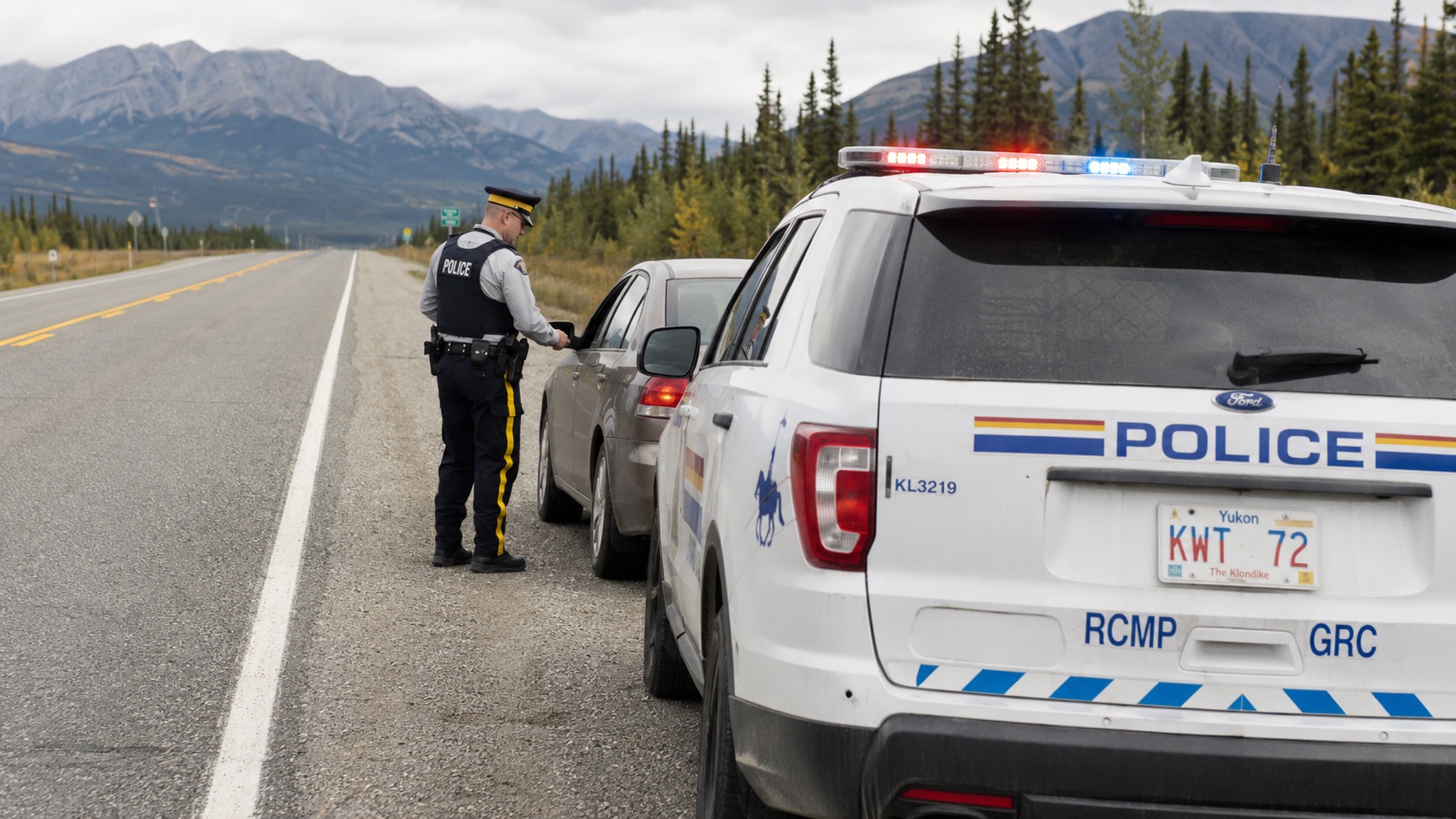
Being pulled over can make even a careful driver nervous. The flashing lights, the sudden interruption, and the authority of the police officer often lead people to answer every question they are asked without considering whether they are legally required to do so.
Drivers must cooperate with certain lawful requirements during a traffic stop. That does not necessarily mean they must explain where they have been, where they are going, what they have been doing, or why they may have committed the alleged traffic violation.
Understanding that distinction can help prevent a routine traffic stop from developing into a broader investigation.
What You Must Provide During a Yukon Traffic Stop
When a police officer directs you to stop, you must pull over safely. Yukon law also requires drivers to produce certain driving documents when lawfully requested, including a driver’s licence and documents relating to the vehicle.
Refusing to identify yourself properly or provide documents you are legally required to carry can create additional consequences.
Drivers should also comply with lawful directions concerning the immediate administration and safety of the stop. An officer may, for example, direct a driver to remain inside the vehicle, step outside, or move the vehicle to a safer location.
Do You Have to Answer the Officer’s Questions?
Police officers commonly ask questions such as:
- Do you know why I pulled you over?
- Where are you coming from?
- Where are you going?
- Have you had anything to drink?
- Is there anything in the vehicle I should know about?
Many people assume that they must answer every question. Generally, however, a driver is not required to assist with a broader investigation simply because an officer asks questions.
A person may politely decline to answer questions that they are not legally required to answer. It is important, however, not to lie, provide a false name, or present false documents. There is a significant difference between calmly declining to answer and deliberately misleading an officer.
Even a casual response can later become evidence. A driver who says they were in a hurry, did not notice the speed limit, consumed alcohol earlier, or were coming from a particular location may provide information that supports a ticket or causes the officer to investigate further.
A Traffic Stop Is Not an Unlimited Investigation
The Supreme Court of Canada considered the limits of a traffic stop in R. v. Mellenthin. The accused was stopped at a police check stop established for traffic-related purposes. The encounter expanded into questioning and a search that uncovered illegal drugs.
The Court found that a lawful check stop does not give police unrestricted authority to conduct a general criminal investigation or search every vehicle and occupant. Police require an appropriate legal basis before expanding the stop into a broader search or investigation.
This does not mean an officer must ignore evidence of another offence. If police observe illegal items, smell alcohol or drugs, notice signs of impairment, or otherwise develop lawful grounds for further investigation, the nature of the stop may change.
Alcohol and Drug Screening Requirements
Drivers should not assume that they can refuse every request made at the roadside. The Criminal Code permits police to make certain alcohol or drug screening demands when the legal requirements are met. It also permits mandatory alcohol screening during a lawful traffic stop in circumstances authorized by the legislation. Failing or refusing to comply with a lawful demand without a reasonable excuse can itself result in a criminal charge.
In R. v. Orbanski; R. v. Elias, the Supreme Court of Canada examined roadside sobriety screening and the right to counsel. The decision recognized that a driver is detained during a police traffic stop and that Charter protections are engaged. It also confirmed that limited roadside screening measures may occur before a driver is given an opportunity to consult a lawyer where those measures are reasonably necessary to assess sobriety.
The practical distinction is important. A driver may be able to decline broad questions about their activities, but refusing a lawful breath, oral-fluid, or other screening demand can create a separate and potentially serious legal problem.
Can Police Search Your Vehicle?
A routine traffic stop does not automatically give police the right to search your vehicle. Police may ask for permission to look inside. A request for consent is not necessarily the same as a lawful direction. You may clearly and respectfully state that you do not consent to a search.
Police may nevertheless have another lawful basis to proceed, depending on what they have observed and the circumstances of the stop. You should not physically resist or interfere with the officer. If the search was unlawful, its legality can be challenged afterward through the court process.
Protecting Your Rights Without Escalating the Stop
Knowing your rights does not require being confrontational. During a traffic stop, remain calm, keep your hands visible, produce the documents you are legally required to provide, and avoid arguing the case at the roadside.
Do not lie to the officer. Do not physically interfere with a search or arrest. You may politely decline questions you are not legally required to answer, and you may state that you do not consent to a search.
If you are arrested, detained further, accused of impaired driving, or believe your rights were violated, speak with a criminal defence lawyer as soon as possible.
Every traffic stop is fact-specific. What begins as a speeding allegation can sometimes develop into an impaired driving investigation, a vehicle search, or a criminal charge. Knowing your rights means understanding what the law requires, what may remain optional, and when legal advice is needed.
Important Legal Disclaimer
This article is provided for general informational purposes only and does not constitute legal advice. The law may change, and the rights, obligations, and legal options that apply during a traffic stop depend on the particular facts and circumstances of each situation.
Reading this article, visiting this website, contacting Jensen Law, or submitting information through the website does not by itself create a solicitor-client relationship. A solicitor-client relationship is only established after Jensen Law has agreed to act in a particular matter.
You should not act, or refrain from acting, based solely on the information in this article without obtaining legal advice from a qualified lawyer who has reviewed your specific circumstances. Jensen Law does not guarantee that the information in this article is complete, current, or applicable to every situation and accepts no responsibility for losses or consequences arising from reliance on this content.